
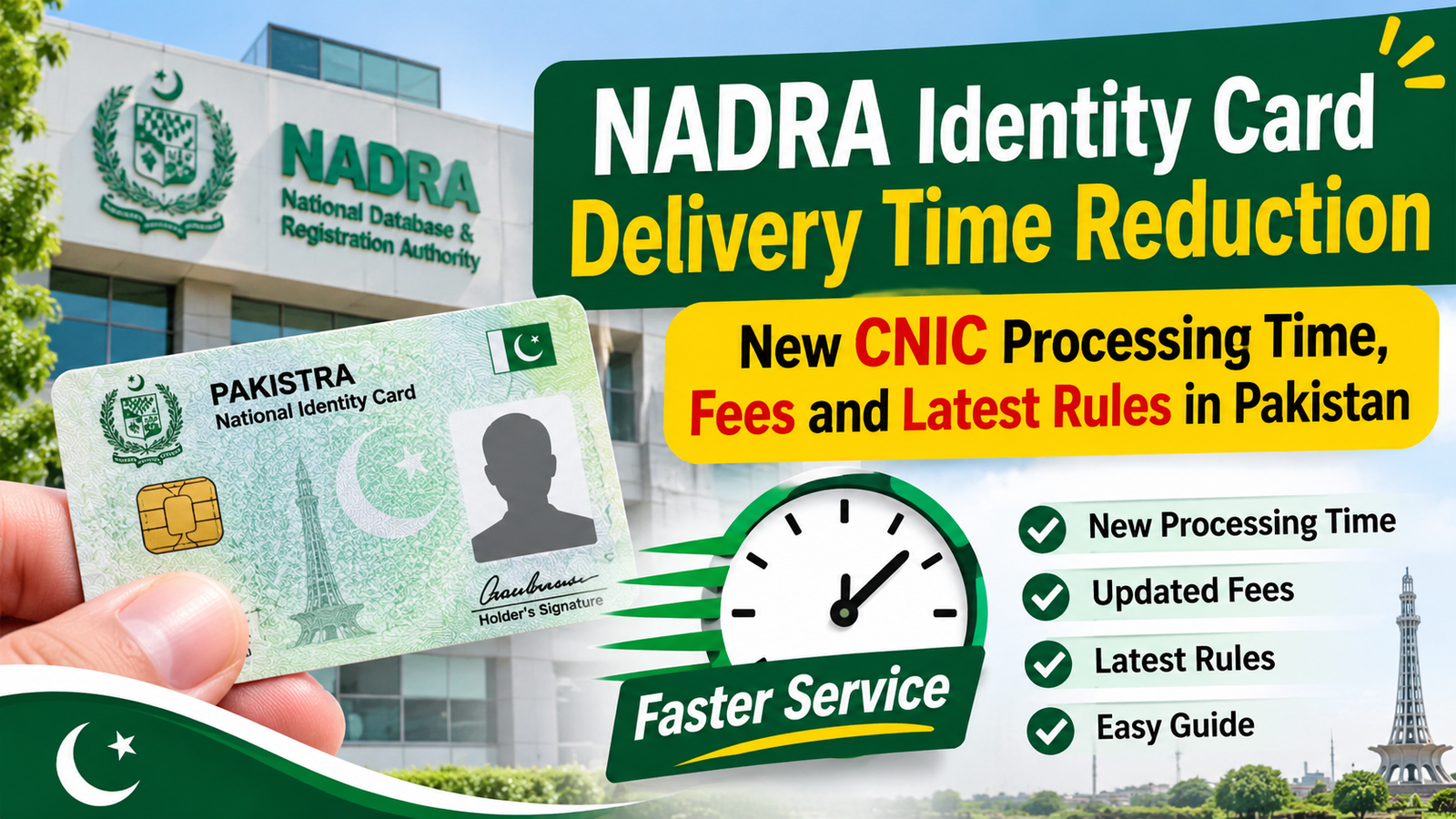
NADRA Identity Card Delivery Time Reduction: New CNIC Processing Time, Fees and Latest Rules in Pakistan
NADRA has brought some major changes in the procedure for issuing the national identity cards in Pakistan. These changes are intended to make the services related to national identity card issuance quicker, safer and more convenient for the citizens of the country.
Some of the changes include the delivery time reduction for CNICs and the changes to identity cards’ security, Child Registration Certificate (CRC), Family Registration Certificate (FRC), as well as to the management of personal information.
In this article, we are going to discuss the latest changes introduced by NADRA, the new processing time for CNIC, the fees for the CNIC application, the registration process and the ways to track your identity card application in Pakistan.
NADRA Identity Card Delivery Time Reduction: New Processing Schedule
NADRA has revised its system for processing of the national identity cards in order to facilitate the citizens in getting their documents more quickly.
There are three processing categories that applicants may choose based on the urgency of the CNIC delivery.
Here is the updated processing schedule for a new CNIC:
| CNIC Category | Processing Time | Fee |
|---|---|---|
| Normal CNIC | 15 days | Free |
| Urgent CNIC | 12 days | Rs. 1,150 |
| Executive CNIC | 6 days | Rs. 2,150 |
This list of timelines and costs is present in the official fee structure of NADRA.
In the new schedule, applicants have the freedom to select different categories depending on the type of processing needed. Those who don’t need urgent processing may apply under the normal category, whereas people who require the documents urgently can opt for the urgent or executive category.
Note: Processing smart CNICs has a unique fee and timeline structure. It is advised that applicants check the particular category before submitting their applications.
CNIC Verification Features without Additional Cost
Along with decreasing the processing time, NADRA has made some improvements to the security features of the identity documents as well.
Improvements include:
Bilingual Information: Information on the identity card may be provided in both Urdu and English.
QR Code Validation: The use of QR code gives another way to verify the identity card information.
Improved Security of Documents: Better security measures have been incorporated into the documents for identity validation.
Cost-effective Registration: NADRA has kept its registration process cost effective.
All these changes will prove helpful for the citizens requiring secure identity documents for various purposes, such as banking, governmental departments, telecom and other official functions.
NADRA New Rules: Important Changes in the Identity System of Pakistan
There are certain amendments made in the National Identity Card Rules, 2002, in order to make the identity management of the citizens better.
The new rules include several aspects, including registration of children, family information, biometric verification, and identity document management.
Now, let us see some important changes.
New Requirements for Child Registration Certificate (B-Form)
NADRA has made changes in the requirements of registration of children to ensure that the information about family and identity remains accurate.
The new system has separate requirements based on age groups:
Below three years of age: Biometric data will not be needed.
From three to ten years of age: Photograph and iris data will be required during the registration process.
From ten to eighteen years of age: Complete biometric data will be required, which will include fingerprints as well as iris data.
Registration of birth through Union Council will also be an important part of obtaining the certificate.
2.Updates in Family Registration Certificate (FRC)
Family Registration Certificate (FRC) is a vital certificate that carries information about the registered family members of a person.
In the revised NADRA rules, different categories of family relations have been included for better management of family records.
These three categories include:
Alpha Family: Relations of family by blood ties such as parents and siblings.
Beta Family: Relations of family through marital tie such as spouses and children.
Gamma Family: Family relations established through adoption.
The revised system helps in recording family details even in case of multiple marriages and unregistered family members as well.
In this way, citizens can know about the mistakes and discrepancies of their family records and make requests for correction from NADRA.
3.Married Women Have the Option to Select Parentage Information
Yet another significant trend pertains to identity information of married women.
In the new system, married women can opt for keeping the surname of their father or adopting the name of their husband on their identity cards, depending upon the policies of NADRA.
Such a trend facilitates greater flexibility in the management of personal identity information and also respects the preferences of individuals in this regard.
It also signifies an important move towards making identity services more citizen-friendly.
NADRA’s Digital Identification Framework and Regulation Changes
In addition to these changes, there are attempts to provide clear and concise definitions of terms used in the process of identity confirmation.
Biometric data represents another vital element of the new regulation. These are the features used for identity verification such as face images and fingerprints.
There are procedures outlined concerning the verification, cancellation, confiscation, and digital marking of identification documents.
The changes may help improve coordination between NADRA and other governmental organizations such as State Bank of Pakistan (SBP), Federal Board of Revenue (FBR), and Pakistan Telecommunication Authority (PTA).
Enhanced Transparency in NADRA Identity Verification Process
The verification process along with correction of identity information is necessary for the reliability of the national registration database.
In the new framework, there are provisions for resolving cases where the identity information is either disputed, incorrect, or doubtful.
The verification committees at various administrative levels need to consider such cases within the stipulated time frames.
In addition to that, citizens may approach NADRA for correcting their incorrect identity information.
The applicant may opt for PakID mobile application or visit NADRA Registration Center depending upon the type of correction needed.
This is because incorrect identity information may result in problems while using government services and facilities.
Importance of Recent Changes in NADRA
NADRA has not just focused on improving the processing speed of the CNICs but has worked towards the modernization of the identity system of Pakistan.
There are several advantages that can be listed for the recent changes introduced by NADRA, such as:
Fast Processing Time: It is helpful in getting identity documents without much delay.
Improved Authenticity: With improved security features and QR code-based authentication, there is going to be more authentic identity documentation.
Accurate Family Information: Improved CRC and FRC processes can help keep accurate family records.
Digital Registration Services: The PakID mobile application allows citizens to perform several services without needing to visit the office all the time.
More Convenient Access to Services: Various registration categories and services available at affordable prices make it easier for everyone to get an identity document.
Final Thoughts
The NADRA identity card delivery time reduction is an important development for Pakistani citizens who want faster access to their identity documents.
With a 15-day normal CNIC processing timeline, 12-day urgent service, and 6-day executive service, applicants have different options depending on their requirements.
In addition, changes to child registration, family records, identity verification, and digital services demonstrate NADRA’s continued efforts to improve Pakistan’s identity management system.
Citizens should always consult NADRA’s official website for the latest processing timelines, fees, and application requirements before submitting their documents.
Frequently Asked Questions (FAQs)
1. How long does it take to receive a CNIC in Pakistan?
According to NADRA’s official fee structure, a new normal CNIC takes approximately 15 days. Urgent processing takes 12 days, while executive processing takes 6 days.
2. What is the fee for a new CNIC in Pakistan?
The new CNIC fee depends on the selected processing category:
- Normal: Free
- Urgent: Rs. 1,150
- Executive: Rs. 2,150
These fees apply to a new regular CNIC. Smart CNIC fees are different.
3. What are the latest NADRA rules in Pakistan?
The updated rules cover child registration, family relationships, biometric information, identity verification, and identity document management. They also recognize Alpha, Beta, and Gamma family categories.
4. How can I check my NADRA CNIC application status?
You can check your application status through NADRA’s official PakID mobile application. You can also contact NADRA’s customer support at 1777 for application-related assistance.
5. What are the three family categories in NADRA?
NADRA recognizes three main family categories:
- Alpha: Family relationships by birth.
- Beta: Family relationships through marriage.
- Gamma: Family relationships through adoption.
6. Can a married woman keep her father’s name on her CNIC?
Yes. Updated arrangements allow married women to choose their father’s or husband’s name on their identity documents, subject to the applicable NADRA procedures.
7. What is the fee for a Smart CNIC in Pakistan?
According to NADRA’s current published fee structure, the new Smart CNIC charges are:
- Normal: Rs. 750
- Urgent: Rs. 1,500
- Executive: Rs. 2,500
8. What is the difference between a CNIC and a Smart CNIC?
A regular CNIC is a standard identity document, while a Smart CNIC contains an embedded microchip with additional security and identification features.
9. Can I apply for a CNIC through the NADRA mobile application?
Yes. Eligible applicants can use NADRA’s official PakID mobile application to submit applications, upload documents, complete applicable verification steps, and track their application progress.
10. Is the first CNIC free in Pakistan?
Yes. NADRA’s published fee structure lists the first new regular CNIC under the normal category as free of charge. Additional processing categories and Smart CNIC services have separate fees.
Reference
NADRA: CNIC



Leave a Reply