
Islam is one of the world’s major religions, followed by millions of people across different countries, cultures and communities. But what does Islam actually mean? What is the origin of the word, and what does it mean to be a Muslim?
The word Islam comes from the Arabic language and is commonly understood as submission or surrender to the will of Allah. It represents a way of life based on belief in one God, worship, obedience to divine guidance and good character.
Islam teaches people to live with honesty, kindness, patience, justice and compassion. Its message is not limited to religious rituals but also provides guidance for personal behaviour, family relationships and responsibilities toward society.
In this guide, we will explore the meaning of Islam, its Arabic origin, its religious definition and the relationship between Islam, peace and the word Muslim.
What Is the Meaning of Islam?
The word Islam is an Arabic term commonly translated as submission or surrender to the will of Allah.
In Islamic teachings, Islam means willingly submitting to the commands of Allah, believing in His oneness and following the guidance revealed through His prophets and messengers.
A person who follows Islam is called a Muslim.
The central message of Islam is to worship Allah alone and live according to His guidance.
Islam encourages believers to develop strong faith, maintain good character, fulfil their responsibilities and treat other people fairly.
The Quran explains:
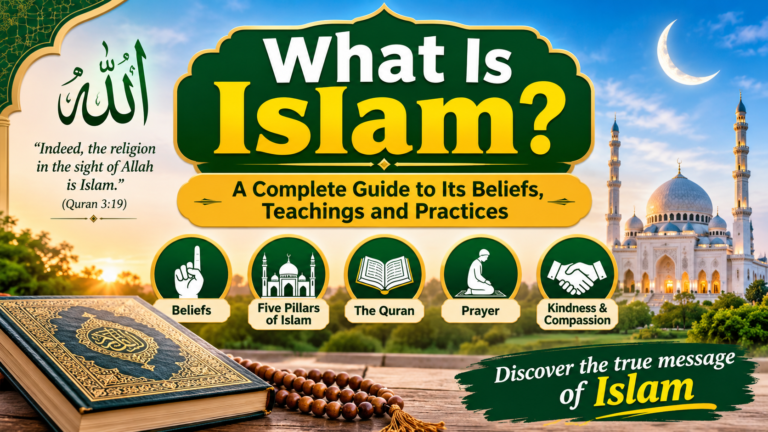
“Indeed, the religion in the sight of Allah is Islam.”
(Surah Aal-e-Imran, 3:19)
This verse highlights the importance of Islam as the religion of submission to Allah.
What Is the Arabic Origin of the Word Islam?
To understand the meaning of Islam, it is helpful to look at its Arabic linguistic origin.
The word Islam is derived from the Arabic root letters س ل م (S-L-M), which are associated with meanings connected to peace, safety, wholeness and submission.
The word Islam is related to the Arabic verb Aslama, which conveys the meaning of submitting or surrendering.
In a religious context, Islam refers to submitting oneself to Allah and accepting His guidance.
Some related Arabic words include:
- Islam: Submission to Allah.
- Muslim: A person who submits to Allah.
- Salam: Peace.
- Aslama: To submit or surrender.
Although Islam is associated with peace, its direct religious meaning is submission to Allah. Peace, security and harmony are important values encouraged by Islamic teachings.
What Does Islam Mean in Religious Terms?
In religious terms, Islam means accepting Allah as the only God worthy of worship and following the guidance He revealed to His messengers.
Islam teaches that Allah created humanity and provided guidance through prophets throughout history.
Muslims believe that the same fundamental message of worshipping one God was taught by earlier prophets, including Adam, Nuh (Noah), Ibrahim (Abraham), Musa (Moses) and Isa (Jesus), peace be upon them all.
Muslims believe that Prophet Muhammad (peace be upon him) was the final messenger of Allah.
Islamic teachings emphasize three important aspects:
1. Belief in One God
The foundation of Islam is Tawheed, which means believing in the absolute oneness of Allah.
Muslims believe that Allah has no partners, equals or children and that only He deserves worship.
2. Submission to Allah
Islam teaches believers to accept Allah’s guidance and follow His commands.
This submission includes worship, honesty, fulfilling responsibilities and avoiding injustice.
3. Living a Righteous Life
Islam encourages people to develop good character and treat others with kindness.
It emphasizes truthfulness, patience, forgiveness, charity, justice and respect for others.
What Does the Word Muslim Mean?
The word Muslim refers to a person who follows Islam and submits to the will of Allah.
A Muslim believes in one God and accepts the teachings of Islam.
The word Muslim is also derived from the same Arabic linguistic root associated with Islam.
Anyone who sincerely accepts the Islamic faith can be a Muslim, regardless of nationality, language, ethnicity or cultural background.
Muslims live in different parts of the world, including Asia, Africa, Europe, North America and Australia.
Is Islam the Same as Peace?
Islam and peace are closely associated in Islamic teachings, but their meanings should be understood accurately.
The word Islam is commonly translated as submission to Allah, while the Arabic word Salam means peace.
Islam encourages believers to establish peace through good conduct, fairness, compassion and respect for others.
The Quran teaches:
“And Allah invites to the Home of Peace.”
(Surah Yunus, 10:25)
This verse refers to Allah inviting people toward Dar al-Salam, commonly understood as the Home of Peace.
Islamic teachings discourage oppression, injustice and unnecessary harm. They encourage Muslims to resolve conflicts fairly, forgive others where appropriate and maintain peaceful relationships.
Therefore, peace is an important value in Islam, while submission to Allah is the central meaning of the religion.
What Is the Main Message of Islam?
The main message of Islam is to worship Allah alone and follow the guidance revealed through His prophets and messengers.
Islam provides guidance for both spiritual and everyday life.
Some of its fundamental teachings include:
Worship Allah Alone
Muslims are instructed to worship Allah without associating partners with Him.
Follow Divine Guidance
Islam encourages believers to study the Quran and follow the authentic teachings of Prophet Muhammad (peace be upon him).
Be Honest and Trustworthy
Truthfulness and fulfilling promises are important qualities encouraged by Islam.
Help People in Need
Charity, generosity and supporting vulnerable people are significant parts of Islamic teachings.
Respect Parents and Family
Islam emphasizes kindness toward parents, maintaining family relationships and fulfilling the rights of relatives.
Establish Justice
Muslims are encouraged to act fairly, avoid oppression and respect the rights of others.
What Is the Difference Between Islam and Other Religions?
Islam shares certain beliefs with other Abrahamic religions, particularly Judaism and Christianity.
All three traditions have historical connections to the belief in one God and include important religious figures such as Ibrahim (Abraham) and Musa (Moses).
However, Islam has its own fundamental beliefs and religious teachings.
Some important Islamic beliefs include:
- Absolute belief in the oneness of Allah.
- Acceptance of all prophets sent by Allah.
- Belief in Prophet Muhammad (peace be upon him) as the final messenger.
- Acceptance of the Quran as the final divine revelation.
- Belief in resurrection and the Day of Judgment.
Muslims also believe in Prophet Isa (Jesus, peace be upon him) as an important messenger of Allah, but do not consider him to be God.
Understanding these beliefs helps explain the identity and religious foundations of Islam.
How Is Islam Practiced in Everyday Life?
Islam is not limited to beliefs alone. It also provides practical guidance for daily living.
Muslims express their faith through worship, ethical behaviour and fulfilling their responsibilities.
The Five Pillars of Islam represent the fundamental acts of worship:
- Shahada: Declaration of faith.
- Salah: Five daily prayers.
- Zakat: Obligatory charity.
- Sawm: Fasting during Ramadan.
- Hajj: Pilgrimage to Makkah for those who are able.
Beyond these acts of worship, Muslims are encouraged to maintain honesty in business, respect neighbours, care for family members and help people experiencing hardship.
These practices reflect the connection between faith and everyday life in Islam.
Why Is Understanding the Meaning of Islam Important?
Understanding the meaning of Islam helps people learn about the foundation of the Islamic faith rather than relying on incomplete information or misconceptions.
It explains why Muslims worship Allah, follow the Quran, perform daily prayers and try to maintain good character.
For someone exploring Islam for the first time, learning its meaning is an important starting point.
It also helps readers understand related Islamic concepts, including Tawheed, Muslim beliefs, the Five Pillars and the teachings of Prophet Muhammad (peace be upon him).
Frequently Asked Questions About the Meaning of Islam
1. What does Islam mean in simple words?
Islam means submission or surrender to the will of Allah. It is based on believing in one God and following His guidance.
2. What is the literal meaning of Islam?
Islam is derived from the Arabic root S-L-M and is commonly understood in its religious context as submission to Allah.
3. What does Islam mean in Arabic?
Islam is written as الإسلام in Arabic. It comes from the Arabic verb Aslama, which conveys submission or surrender.
4. Does Islam mean peace?
The word Islam is primarily understood as submission to Allah, while Salam means peace. Peace is an important value encouraged by Islamic teachings.
5. What does Muslim mean?
A Muslim is a person who follows Islam and submits to the will of Allah.
6. Who is the founder of Islam?
Muslims believe that Islam represents the original message of submission to one God taught by all prophets. Prophet Muhammad (peace be upon him) delivered its final revelation and established the Muslim community in seventh-century Arabia.
7. What is the main purpose of Islam?
The central purpose of Islam is to worship Allah alone, follow His guidance and live a righteous life.
8. What is the main belief of Islam?
The central belief of Islam is Tawheed, which means believing that Allah is one and that only He deserves worship.
Conclusion
Islam means submission to the will of Allah and following His divine guidance. It is a religion based on belief in one God, worship, righteousness and good character.
The meaning of Islam extends beyond religious terminology. Its teachings encourage honesty, justice, compassion, patience, charity and responsibility toward others.
Understanding the meaning of Islam provides a foundation for learning about its beliefs, prophets, Quran and religious practices.
For anyone interested in exploring the Islamic faith, studying the Quran and authentic teachings of Prophet Muhammad (peace be upon him) is an important step toward understanding the true message of Islam.
Leave a Reply