
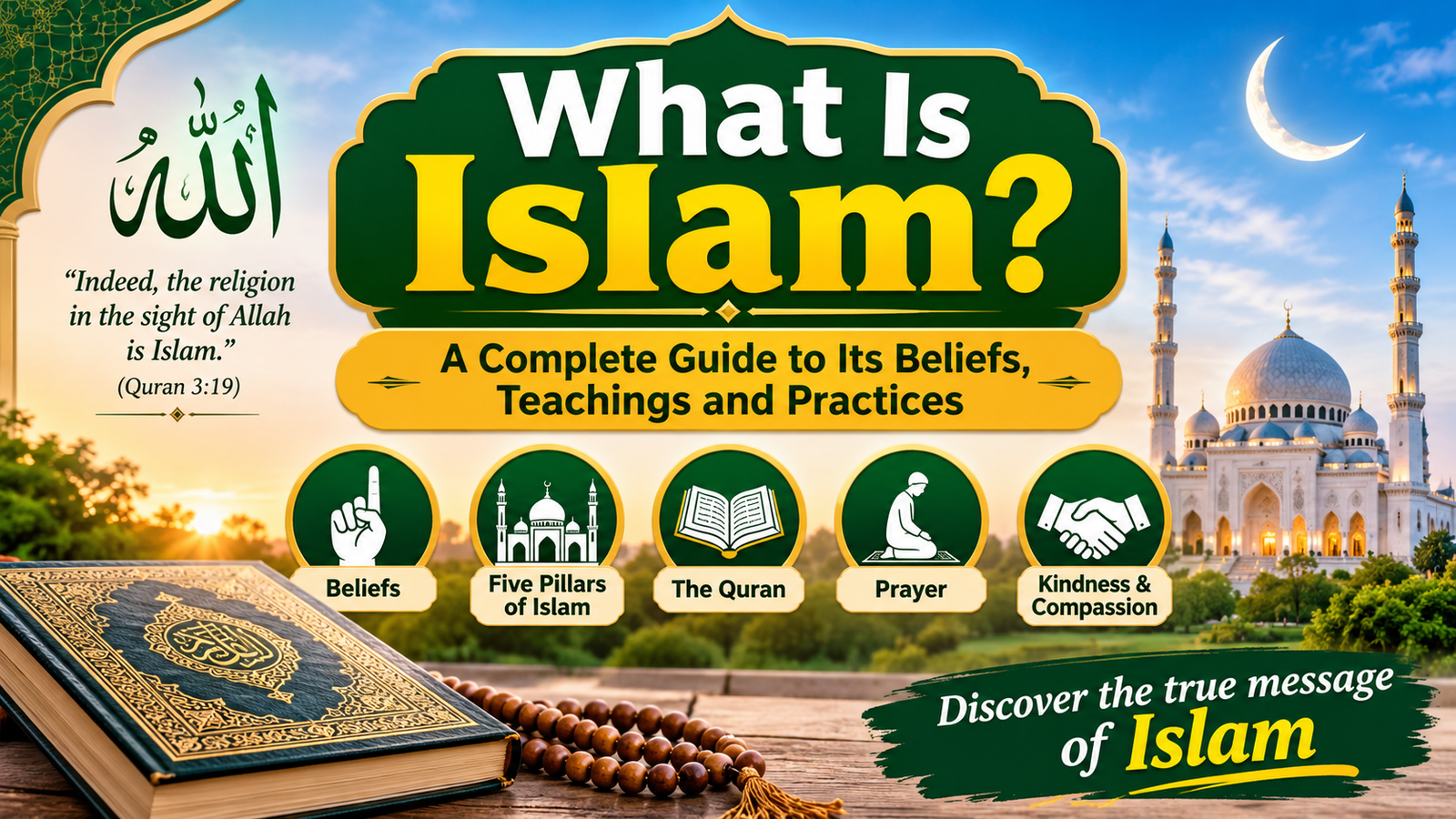
Islam is one of the world’s major monotheistic religions, followed by more than a billion people across different countries and cultures. It teaches belief in one God, known in Arabic as Allah, and provides guidance for personal life, worship, family relationships, morality and society.
For people who are unfamiliar with the Islamic faith, understanding what Islam is can help explain its fundamental beliefs, religious practices and spiritual principles.
Islam is not only about religious rituals. It also emphasizes honesty, kindness, justice, charity, patience, forgiveness and responsibility toward others.
In this complete guide, we will explore the meaning of Islam, its origins, fundamental beliefs, five pillars, holy book, prophets and important teachings.
What Is Islam?
Islam is a monotheistic religion based on the belief in one God, Allah. Muslims believe that Allah is the Creator and Sustainer of everything and that only He deserves to be worshipped.
The word Islam is commonly understood as submission or surrender to the will of Allah. A person who follows Islam is called a Muslim.
Islam teaches that human beings should live according to the guidance revealed by Allah through His prophets and messengers. Muslims believe that Prophet Muhammad (peace be upon him) was the final messenger in this line of prophets.
The central message of Islam is to worship Allah alone, follow His guidance and live a life based on righteousness, compassion and justice.
The Quran describes Islam as the religion accepted by Allah:
“Indeed, the religion in the sight of Allah is Islam.”
(Quran 3:19)
What Is the Meaning of Islam?
The word Islam comes from the Arabic root associated with submission, surrender and peace.
In Islamic teachings, Islam means willingly submitting to Allah and following His commands.
The term Muslim refers to a person who submits to Allah and follows the teachings of Islam.
Islam encourages believers to develop a peaceful relationship with their Creator, treat other people fairly and avoid injustice and wrongdoing.
Who Is Allah in Islam?
Allah is the Arabic name for God. Muslims believe that Allah is one, unique, eternal and the Creator of the entire universe.
The foundation of Islamic belief is that Allah has no partners, children or equals.
Muslims believe in several attributes of Allah, including:
- Ar-Rahman: The Most Merciful.
- Ar-Raheem: The Especially Merciful.
- Al-Khaliq: The Creator.
- Al-Aleem: The All-Knowing.
- Al-Ghafoor: The Most Forgiving.
- As-Samee: The All-Hearing.
These names are among the beautiful names of Allah mentioned in Islamic teachings.
Muslims worship Allah directly without needing an intermediary.
What Are the Main Beliefs of Islam?
Islam has fundamental beliefs that form the foundation of the Islamic faith.
In the well-known Hadith of Angel Jibreel, Prophet Muhammad (peace be upon him) explained the essential articles of faith.
The six fundamental beliefs commonly taught in Sunni Islam are:
1. Belief in Allah
Muslims believe in the existence and oneness of Allah. They believe that He created everything and that no one shares His divine authority.
2. Belief in Angels
Muslims believe that angels are creations of Allah who obey His commands. Jibreel (Gabriel) is especially important because he delivered divine revelations to the prophets.
3. Belief in Revealed Books
Muslims believe that Allah revealed guidance to His messengers through scriptures.
These include:
- The Tawrat (Torah), revealed to Prophet Musa (Moses).
- The Zabur (Psalms), given to Prophet Dawud (David).
- The Injil (Gospel), given to Prophet Isa (Jesus).
- The Quran, revealed to Prophet Muhammad (peace be upon him).
Muslims believe that the Quran is the final revelation from Allah.
4. Belief in Prophets and Messengers
Muslims believe that Allah sent prophets to guide humanity.
Some prophets mentioned in the Quran include:
- Adam (peace be upon him).
- Nuh (Noah).
- Ibrahim (Abraham).
- Musa (Moses).
- Dawud (David).
- Isa (Jesus).
- Muhammad (peace be upon them all).
Muslims believe that Prophet Muhammad (peace be upon him) is the final prophet and messenger.
5. Belief in the Day of Judgment
Muslims believe that everyone will be resurrected and held accountable for their actions.
On the Day of Judgment, Allah will judge people with complete justice. Islamic teachings emphasize that every person is responsible for their choices and deeds.
6. Belief in Divine Decree (Qadar)
Muslims believe that Allah has complete knowledge and control over everything.
Belief in divine decree includes understanding that Allah knows what has happened, what is happening and what will happen.
These six beliefs form an important foundation of Islamic faith.
What Are the Five Pillars of Islam?
The Five Pillars of Islam are the fundamental acts of worship and religious obligations that structure a Muslim’s spiritual life.
1. Shahada – Declaration of Faith
Shahada is the declaration that there is no deity worthy of worship except Allah and that Muhammad is the Messenger of Allah.
It expresses the central belief of Islam: worshipping Allah alone and accepting Prophet Muhammad (peace be upon him) as His final messenger.
2. Salah – Five Daily Prayers
Salah is the obligatory prayer performed five times every day.
The five daily prayers are:
- Fajr – Before sunrise.
- Dhuhr – After midday.
- Asr – Afternoon.
- Maghrib – After sunset.
- Isha – Night.
Prayer helps Muslims remember Allah, maintain spiritual discipline and strengthen their relationship with their Creator.
3. Zakat – Obligatory Charity
Zakat is an obligatory form of charity for Muslims who meet the required conditions.
Eligible Muslims give a prescribed portion of their qualifying wealth to specific categories of people, including those in need.
Zakat promotes generosity, social responsibility and economic support for vulnerable members of society.
4. Sawm – Fasting During Ramadan
Sawm refers to fasting during the Islamic month of Ramadan.
Muslims who are required to fast abstain from food, drink and other actions that invalidate the fast from dawn until sunset.
Fasting encourages patience, self-discipline, gratitude and awareness of the difficulties experienced by people in need.
5. Hajj – Pilgrimage to Makkah
Hajj is the pilgrimage to Makkah in Saudi Arabia.
It is obligatory once in a lifetime for Muslims who have the physical and financial ability to perform it.
Hajj brings Muslims from different countries and backgrounds together in worship of Allah.
What Is the Holy Book of Islam?
The Holy Quran is the central religious scripture of Islam.
Muslims believe that the Quran is the word of Allah, revealed to Prophet Muhammad (peace be upon him) through Angel Jibreel over approximately 23 years.
The Quran contains 114 chapters, known as Surahs, covering subjects such as:
- The oneness of Allah.
- Guidance for human life.
- Stories of earlier prophets.
- Moral values and good character.
- Worship and religious obligations.
- Justice and social responsibilities.
- The Hereafter and Day of Judgment.
Muslims recite the Quran during daily prayers and study its teachings to understand the guidance of Allah.
The Quran is available in Arabic, with translations in many languages to help people around the world understand its meaning.
Who Was Prophet Muhammad (Peace Be Upon Him)?
Prophet Muhammad (peace be upon him) was born in Makkah, in present-day Saudi Arabia, around 570 CE.
Muslims believe that Allah selected him as His final messenger.
At approximately 40 years of age, he received the first revelation through Angel Jibreel in the Cave of Hira.
He spent his life teaching people to worship one God, abandon injustice, care for the poor and treat others with honesty and compassion.
His teachings and practices are preserved in Hadith literature and form an important source of Islamic guidance alongside the Quran.
Muslims consider his life an example of patience, mercy, honesty, humility and good character.
What Does Islam Teach About Daily Life?
Islam provides guidance for different aspects of everyday life.
Some of its important teachings include:
Honesty and Truthfulness
Muslims are encouraged to speak truthfully, keep promises and avoid dishonesty in personal and business dealings.
Kindness and Respect
Islam emphasizes treating parents, relatives, neighbours, children and other people with kindness and respect.
Charity and Helping Others
Helping people in need is strongly encouraged. Islamic teachings emphasize supporting the poor, orphans, travellers and vulnerable members of society.
Justice and Fairness
Muslims are instructed to act fairly, avoid oppression and respect the rights of other people.
Patience and Forgiveness
Patience and forgiveness are important Islamic values. Muslims are encouraged to control anger, forgive others and respond to difficulties with faith and perseverance.
What Is the Difference Between Islam and Muslim?
Islam and Muslim are related terms, but they have different meanings.
Islam is the name of the religion, while a Muslim is a person who follows that religion.
For example:
- Islam is a monotheistic religion.
- A Muslim is someone who believes in and follows Islam.
- Islamic teachings refer to the principles and guidance of the religion.
- Muslim communities consist of people who follow Islam.
People from different countries, languages and cultures can all be Muslims.
How Did Islam Spread Around the World?
Islam began in the Arabian Peninsula during the seventh century CE.
During the lifetime of Prophet Muhammad (peace be upon him), Islam spread throughout much of Arabia.
After his death in 632 CE, Muslim communities expanded into different regions through various historical processes, including trade, migration, scholarship, political developments and religious teaching.
Over the centuries, Islam became established in regions including:
- The Middle East.
- North Africa.
- Central Asia.
- South Asia.
- Southeast Asia.
- Parts of Europe.
- Other regions around the world.
Today, Muslims live in almost every part of the world and represent diverse cultures, languages and communities.
Is Islam a Religion of Peace?
Islam places significant emphasis on peace, mercy, justice and compassion.
The Quran encourages Muslims to pursue peace and avoid injustice and wrongdoing.
Islamic teachings also emphasize protecting human life, helping people in need, respecting others and fulfilling responsibilities toward society.
However, understanding Islam requires studying its religious texts and historical context rather than relying on stereotypes or generalizations.
Muslims are individuals from diverse backgrounds, and their actions should not automatically be treated as a representation of the entire religion.
Frequently Asked Questions About Islam
1. What is Islam in simple words?
Islam is a monotheistic religion based on worshipping one God, Allah, and following His guidance revealed through His prophets, with Prophet Muhammad (peace be upon him) as the final messenger.
2. What does Islam mean?
Islam is commonly understood as submission or surrender to the will of Allah. It emphasizes faith, worship and righteous living.
3. Who founded Islam?
Muslims believe that Islam is the original faith of submission to one God taught by all prophets. Prophet Muhammad (peace be upon him) delivered its final revelation and established the Muslim community in seventh-century Arabia.
4. What do Muslims believe?
Muslims believe in Allah, His angels, revealed books, prophets and messengers, the Day of Judgment and divine decree.
5. What are the Five Pillars of Islam?
The Five Pillars are Shahada, Salah, Zakat, Sawm and Hajj. They represent the fundamental acts of worship in Islam.
6. What is the holy book of Islam?
The Quran is the holy book of Islam. Muslims believe it is the final revelation from Allah to Prophet Muhammad (peace be upon him).
7. How many times do Muslims pray each day?
Muslims perform five obligatory daily prayers: Fajr, Dhuhr, Asr, Maghrib and Isha.
8. Do Muslims believe in Jesus?
Yes. Muslims believe that Prophet Isa (Jesus, peace be upon him) was a messenger of Allah, born miraculously to Maryam (Mary). However, Islam does not consider Jesus to be God or the son of God.
9. Where did Islam begin?
Islam’s final revelation began in Makkah, in the Arabian Peninsula, during the seventh century CE.
10. What makes Islam different from other religions?
Islam emphasizes the absolute oneness of God, the finality of Prophet Muhammad’s message and the Quran as the final divine revelation. It also shares certain beliefs with other Abrahamic religions.
Conclusion
Islam is a religion based on belief in one God, following divine guidance and living a life of faith, worship and good character.
Its fundamental teachings emphasize honesty, justice, compassion, patience, charity and responsibility toward others.
Understanding Islam involves learning about its beliefs, Five Pillars, Quran, prophets and religious practices.
For anyone interested in exploring the Islamic faith, studying the Quran, authentic Hadith and the life of Prophet Muhammad (peace be upon him) provides an important foundation for understanding its teachings.
Leave a Reply