
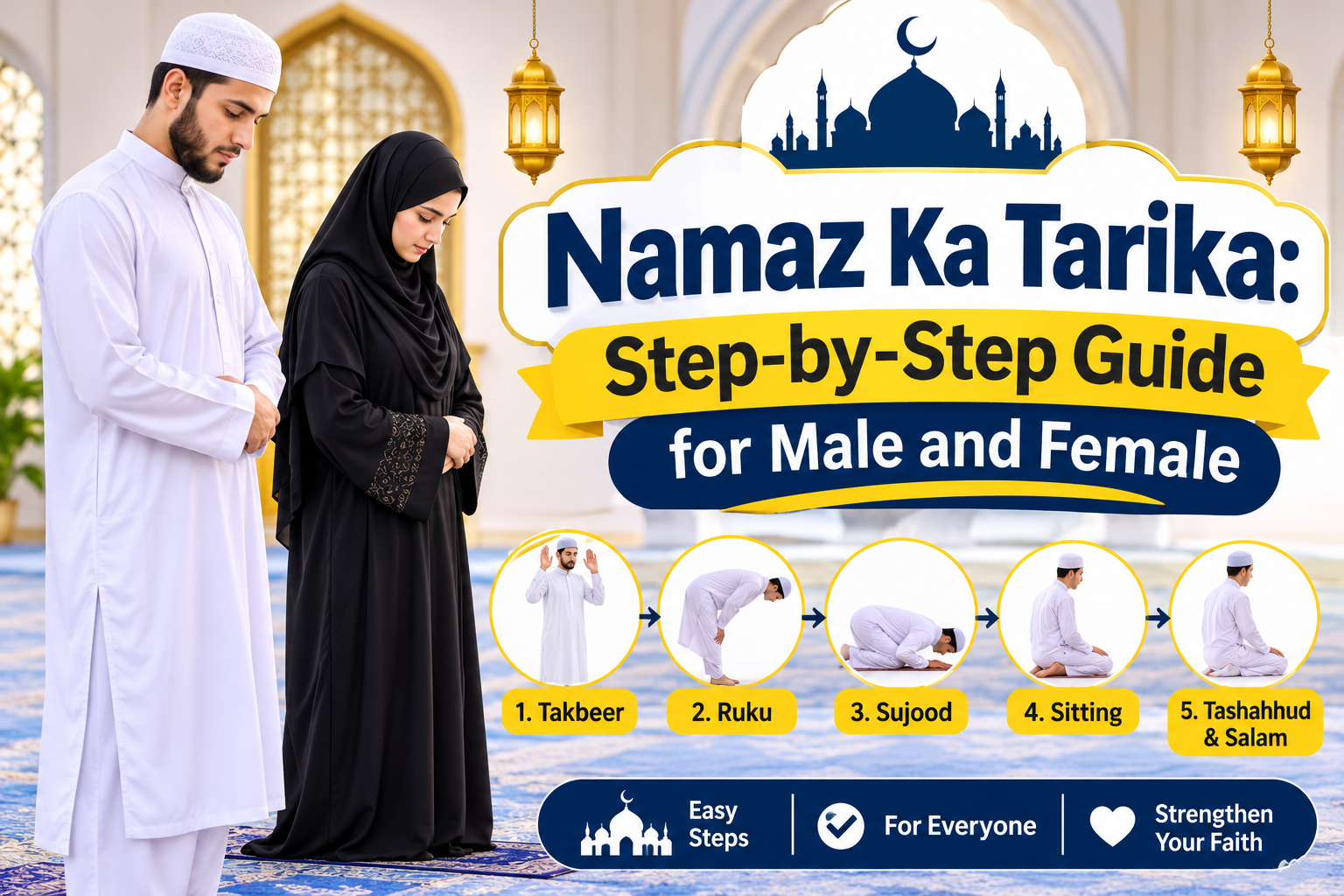
Learn Namaz ka tarika step by step in English, including how to pray for males and females, Sunni and Shia prayer methods, Tahajjud, Tasbeeh and Taraweeh
Namaz Ka Tarika: Step-by-Step Guide for Male and Female in English
Namaz, also known as Salah is one of the important ways to worship in Islam. It is a part of a Muslims everyday life. It helps a person remember Allah ask for forgiveness and grow in faith. Muslims offer five prayers each day. These prayers are called Fajr, Zuhr, Asr, Maghrib and Isha.
It is important for every Muslim to learn the way to perform Namaz whether they are just starting out or want to improve their daily prayers. This guide explains the way to perform Namaz step by step in English. It covers the method for men and women. It also talks about the differences between the way Sunnis pray and the way Shias pray. It includes prayers, like Tahajjud, Tasbeeh and Taraweeh.
What Is Namaz (Salah) in Islam?
Namaz, also known as Salah, is the daily prayer Muslims perform to worship Allah. It is the second pillar of Islam and is obligatory for adult Muslims.
There are five daily obligatory prayers:
| Prayer | Number of Fard Rakats |
|---|---|
| Fajr | 2 |
| Zuhr | 4 |
| Asr | 4 |
| Maghrib | 3 |
| Isha | 4 |
Apart from prayers Muslims can also perform Sunnah, Nafl and other voluntary prayers to increase their worship and earn spiritual rewards.
Namaz Ka Tarika Step by Step
Before starting Namaz make sure your body, clothes and prayer place are clean. Perform Wudu (ablution) face the Qibla and make the intention for Namaz.
Here is a general step-by-step explanation of the followed Sunni Namaz method.
Step 1: Make Niyyah (Intention)
Stand facing the Qibla and make the intention in your heart, for Namaz that you’re about to perform.
For example if you are praying Fajr intend to offer two Rakats of Fajr for the sake of Allah.
It is not necessary to pronounce the intention.
Step 2: Say Takbeer-e-Tahrima
Raise your hands and say:
Allahu Akbar
This means Allah is the Greatest.
After saying Takbeer fold your hands according to the method followed in your school of jurisprudence.
Step 3: Recite Sana
In the followed Hanafi method recite Sana:
“Subhanaka Allahumma wa bihamdika wa tabarakasmuka wa ta’ala jadduka wa la ilaha ghairuk.”
Then recite. Bismillah before Surah Al-Fatihah.
Step 4: Recite Surah Al-Fatihah
Recite Surah Al-Fatihah, the opening chapter of the Holy Quran.
After Surah Al-Fatihah, recite another Surah or some verses from the Quran in the two Rakats of an obligatory prayer.
Step 5: Perform Ruku (Bowing)
Say Allahu Akbar. Bow down placing your hands on your knees.
Keep your back straight and recite:
“Subhana Rabbiyal Azeem” (usually three times).
This means: Glory be to my Lord, the Great.
Step 6: Stand After Ruku
Rise from Ruku. Say:
“Sami Allahu liman hamidah.”
standing, say:
“Rabbana lakal hamd.”
This means that all praise belongs to Allah.
Step 7: Perform the First Sajdah
Say Allahu Akbar and go into Sajdah (prostration).
Place your forehead and nose on the ground along with your hands, knees and toes.
Recite:
“Subhana Rabbiyal A’la” ( three times).
This means: Glory be to my Lord, the High.
Step 8: Sit Between Two Sajdahs
Say Allahu Akbar. Sit briefly between the two prostrations.
Then say Allahu Akbar again. Perform the second Sajdah.
Recite “Subhana Rabbiyal A’la” again.
You have now completed one Rakat.
Step 9: Complete the Second Rakat
Stand for the Rakat and repeat the following:
- Recite Surah Al-Fatihah.
- Recite another Surah or Quranic verses.
- Perform Ruku.
- Stand after Ruku.
- Perform two Sajdahs.
After completing the Rakat sit and recite Attahiyyat.
Step 10: Recite Durood and Dua
If this is your final sitting, recite:
- Attahiyyat
- Durood-e-Ibrahim
- A suitable Dua
Then turn your face to the right and say:
“Assalamu Alaikum wa Rahmatullah.”
Repeat on the side.
Your Namaz is now complete.
Note: The exact recitations, hand positions and certain movements differ between schools of jurisprudence. This is an explanation of a commonly followed Sunni method, particularly the Hanafi method.
Namaz Ka Tarika for Male
The structure of Namaz is the same for men and women although some details of posture differ according to the jurisprudential school followed.
In the taught Hanafi method men generally:
- Raise their hands to the level of their ears when beginning Namaz.
- Fold their hands below the navel.
- Keep their elbows positioned during Ruku.
- Keep their fingers together while performing Sajdah.
- Sit in the posture during the final sitting.
Men should also ensure that their clothing covers the area (from the navel to the knees according to the relevant rulings).
Namaz Ka Tarika for Female
Women also perform the five obligatory prayers. The essential recitations and sequence of Namaz remain the same.
In the taught Hanafi method some traditional instructions for women include:
- Raise the hands around shoulder level when beginning Namaz.
- Fold the hands on the chest.
- Keep the body compact during Ruku.
- Keep the arms closer to the body during Sajdah.
- Sit with both legs positioned to one side in the sitting posture.
Women should observe the requirements for covering their bodies during prayer.
Important: These posture differences are not identical across all schools. Muslims should follow guidance from their own school of jurisprudence.
Namaz Ka Tarika Step by Step Sunni
Sunni Muslims follow the Quran and Sunnah. There are differences in certain prayer details among the four major Sunni schools:
- Hanafi
- Shafi’i
- Maliki
- Hanbali
For example hand placement, raising the hands during certain movements and some sitting positions may differ.
However the essential structure of Salah remains familiar: intention, Takbeer, Quranic recitation, Ruku, Sajdah and the final sitting.
Shia Namaz Ka Tarika
Shia Muslims also perform five daily prayers. Their prayer method has some differences from followed Sunni methods.
Some important differences include:
- Shia Muslims generally keep their hands by their sides while standing.
- They perform Sajdah on materials, commonly a small clay tablet called a Turbah.
- They recite supplications and follow their own jurisprudential instructions.
- They commonly combine Zuhr with Asr and Maghrib with Isha while Fajr is performed separately.
The basic purpose of prayer remains worship and remembrance of Allah. For instructions Shia Muslims should follow the rulings of their recognized religious authority.
Tahajjud Namaz Ka Tarika
Tahajjud is a voluntary night prayer performed after Isha and before Fajr. It is particularly associated with worship during the third of the night.
How to perform Tahajjud:
- Wake up during the night after sleeping.
- Perform Wudu.
- Make the intention to offer Tahajjud.
- Pray two Rakats at a time.
- Recite Surah Al-. Another Surah in each Rakat.
- Complete. Sajdah normally.
- Continue praying according to your ability.
There is no fixed number of Tahajjud Rakats. Two Rakats are sufficient for a prayer and you can offer more.
After Tahajjud make Dua. Ask Allah for forgiveness, guidance and blessings.
Tasbeeh Namaz Ka Tarika (Salat al-Tasbih)
Salat al-Tasbih is a prayer associated with the recitation of a special Tasbeeh.
The Tasbeeh is:
“SubhanAllahi walhamdulillahi wa la ilaha illallahu wallahu Akbar.”
The described method consists of four Rakats and 300 Tasbeeh recitations in total.
The distribution, in each Rakat is:
| Prayer Position | Number of Tasbeeh |
|---|---|
| After Sana | 15 |
| After Surah Al-Fatihah and another Surah | 10 |
| During Ruku | 10 |
| After rising from Ruku | 10 |
| First Sajdah | 10 |
| Between the two Sajdahs | 10 |
| Second Sajdah | 10 |
| Total per Rakat | 75 |
Repeat this method for four Rakat to complete 300 Tasbeeh recitations.
Follow a scholarly guide for the detailed recitation sequence and rulings.
Taraweeh Ki Namaz Ka Tarika
Taraweeh is a voluntary prayer performed during the month of Ramadan after Isha prayer.
The prayer is commonly performed in congregation at mosques. Can also be offered individually.
How to perform Taraweeh:
- Perform Isha prayer.
- Make the intention for Taraweeh.
- Pray two Rakat at a time.
- Recite Surah Al-. Another Surah in each Rakat.
- Complete. Sajdah.
- Continue until completing the chosen number of Rakat.
Many mosques perform 20 Rakat while some communities follow an eight-Rakat practice. Both practices have discussions and established traditions.
Taraweeh is an opportunity to listen to and recite the Holy Quran throughout Ramadan.
Important Things to Remember Before Namaz
Before offering Namaz Muslims should ensure the following conditions are fulfilled:
- Purity: Perform Wudu. Ensure the body, clothes and prayer place are clean.
- Qibla: Face the direction of the Kaaba in Makkah.
- Prayer Time: Perform each prayer within its prescribed time.
- Clothing: Cover the required parts of the body.
- Intention: Have the intention to perform the prayer.
- Concentration: Try to understand the recitations and maintain focus during prayer.
Frequently Asked Questions (FAQs)
1. How to learn Namaz ka tarika for beginners?
Beginners should first learn Wudu, the five prayers, Surah Al-Fatihah, basic recitations and the correct movements of Salah. Practicing regularly with a teacher or guide can make learning easier.
2. What is the correct Namaz ka tarika step by step?
The general prayer sequence includes Niyyah, Takbeer, Quranic recitation, Ruku, standing after Ruku, two Sajdahs and the prescribed sitting and Salam. Details can vary according to jurisprudence.
3. How many Rakat are compulsory in five prayers?
There are 17 Rakat in the five daily prayers: two in Fajr, four in Zuhr four in Asr three in Maghrib and four in Isha.
4. Is Namaz different for males and females?
The essential structure and Quranic recitations are the same. Some traditional schools prescribe differences in posture and clothing requirements.
5. Can women perform Namaz at home?
Yes. Women can perform their prayers at home or in other appropriate places where prayer is permitted.
6. What is Tahajjud Namaz?
Tahajjud is a voluntary night prayer performed after Isha and before Fajr after waking from sleep.
7. How many Rakat are in Taraweeh?
Taraweeh is commonly performed as 20 Rakat or eight Rakat depending on the community and scholarly tradition.
8. What is Salat al-Tasbih?
Salat al-Tasbih is a four-Rakat prayer in which a special Tasbeeh is recited 300 times in total.
9. Can Sunni and Shia Muslims pray together?
Muslims can pray in the congregation in appropriate circumstances although certain prayer practices and jurisprudential details differ. Muslims should respect one anothers established traditions.
10. Why is Namaz important, in Islam?
Namaz is one of the five pillars of Islam. Namaz strengthens faith encourages discipline develops gratitude and keeps Muslims connected with Allah.



Leave a Reply