US Strikes Iranian Oil Tankers as Iran Attacks US Base in Jordan
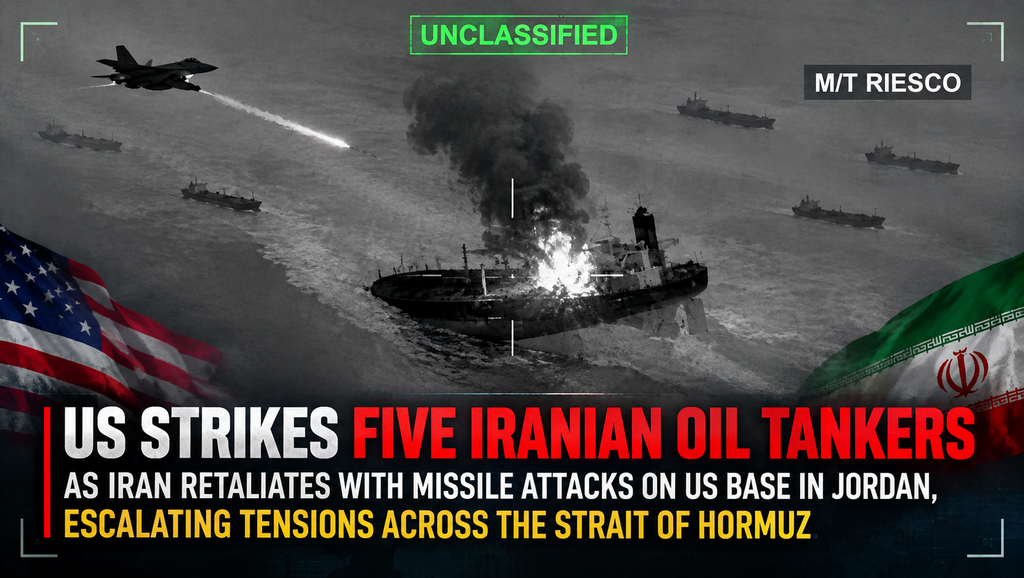
US strikes five Iranian oil tankers as Iran retaliates with missile attacks on a US base in Jordan, escalating tensions across the Strait of Hormuz.
The conflict between the United States and Iran has escalated sharply after US forces struck five Iranian oil tankers, while Iran retaliated by launching ballistic missiles toward a US military base in Jordan and claiming attacks on several vessels in the strategic Strait of Hormuz.
The latest confrontation marks another major escalation in the more than six-month-old conflict, with military operations now affecting oil tankers, commercial shipping, energy infrastructure and key military positions across the region.
US Strikes Five Iranian Oil Tankers
The US military said it destroyed five Iranian oil tankers on Tuesday after Iran’s Islamic Revolutionary Guard Corps (IRGC) targeted a US warship with ballistic missiles.
US Central Command (Centcom) said the Iranian attacks on the American vessel were successfully evaded and that no US personnel were injured.
According to the US military, four of the Iranian tankers were targeted in the Gulf of Oman, while another was struck near Kharg Island, one of Iran’s most important oil-export terminals.
The United States said the tankers were connected to an Iranian “shadow network” that generates billions of dollars to support the IRGC and its regional allies.
One of the vessels, the M/T Riesco, later sank in the Gulf of Oman after being struck.
Iran Retaliates With Missile Attack on Jordan
Iran responded to the US strikes by launching ballistic missiles toward a US military facility in Jordan.
Jordanian authorities said its air-defence systems intercepted 18 of 20 Iranian missiles, while the remaining two landed in unpopulated areas. No casualties were reported in the initial accounts.
Iran’s Revolutionary Guards said the attack was part of its response to the latest US strikes against Iranian oil vessels.
The Iranian military also claimed that it attacked two US vessels, eight oil tankers and 10 other vessels that it described as “non-compliant” while they attempted to pass through the Strait of Hormuz.
Strait of Hormuz Becomes a Major Flashpoint
The Strait of Hormuz has become one of the most important flashpoints in the growing US-Iran confrontation.
The narrow waterway is a critical route for global oil transportation, and any prolonged disruption could have consequences for energy markets around the world.
Recent data shows that shipping activity through the Strait of Hormuz has already fallen significantly. On Tuesday, only six commodity vessels passed through the waterway, compared with a 10-day average of 12 vessels, according to shipping data cited by Reuters.
The reduction in maritime traffic has increased concerns about potential disruptions to global oil supplies.
Oil Prices Move Higher
The latest military escalation has also pushed oil prices higher.
Brent crude moved close to the $100-per-barrel level, while US West Texas Intermediate crude also rose as traders assessed the possibility of further disruptions to oil production and transportation in the Middle East.
The Strait of Hormuz is particularly important because a large volume of global energy supplies normally passes through the waterway.
However, alternative export routes and continued oil flows have helped prevent prices from moving even higher so far. Reuters reported that Gulf producers have been using alternative routes and ports to maintain some exports despite the disruption.
Kharg Island’s Importance to Iran’s Oil Exports
The US strikes near Kharg Island are particularly significant because the island hosts Iran’s main crude oil export terminal.
A large share of Iran’s crude exports traditionally passes through the facility before being transported through the Gulf.
Any prolonged disruption around Kharg Island could therefore put additional pressure on Iran’s ability to export oil and could further affect international energy markets.
Houthi Attacks Add to Regional Tensions
The latest US-Iran escalation is also taking place alongside attacks by Iran-backed Houthi forces in Yemen.
Saudi authorities said Houthi drones and missiles targeted energy facilities and civilian infrastructure, causing fires and temporarily disrupting operations. Saudi authorities reported that 73 people were injured in the attacks.
The combination of attacks on oil infrastructure, tankers and strategic shipping routes has increased concerns about the wider security of energy supplies across the Middle East.
Shipping Risks Increase in the Gulf
The growing confrontation has made commercial shipping increasingly difficult in the region.
Iran has previously warned vessels about routes through the Strait of Hormuz, while the United States has increased military activity aimed at protecting its forces and maintaining access to important maritime routes.
The latest attacks have therefore created additional uncertainty for shipping companies, oil traders and governments that depend on stable energy supplies.
US-Iran Conflict Enters Another Dangerous Phase
The latest exchange represents a significant escalation after a period of relative calm.
The United States has targeted Iranian oil infrastructure and vessels, while Iran has increasingly focused its response on US military assets and maritime traffic.
The conflict is now affecting not only military forces but also international shipping and energy markets, increasing the risk that further attacks could spread across the wider region.
With oil prices approaching $100 per barrel and shipping traffic through the Strait of Hormuz declining, markets are closely watching whether the US and Iran continue their cycle of retaliatory strikes.
For now, the situation remains highly volatile, with further developments likely to determine the future of oil supplies, shipping security and stability across the Middle East.