
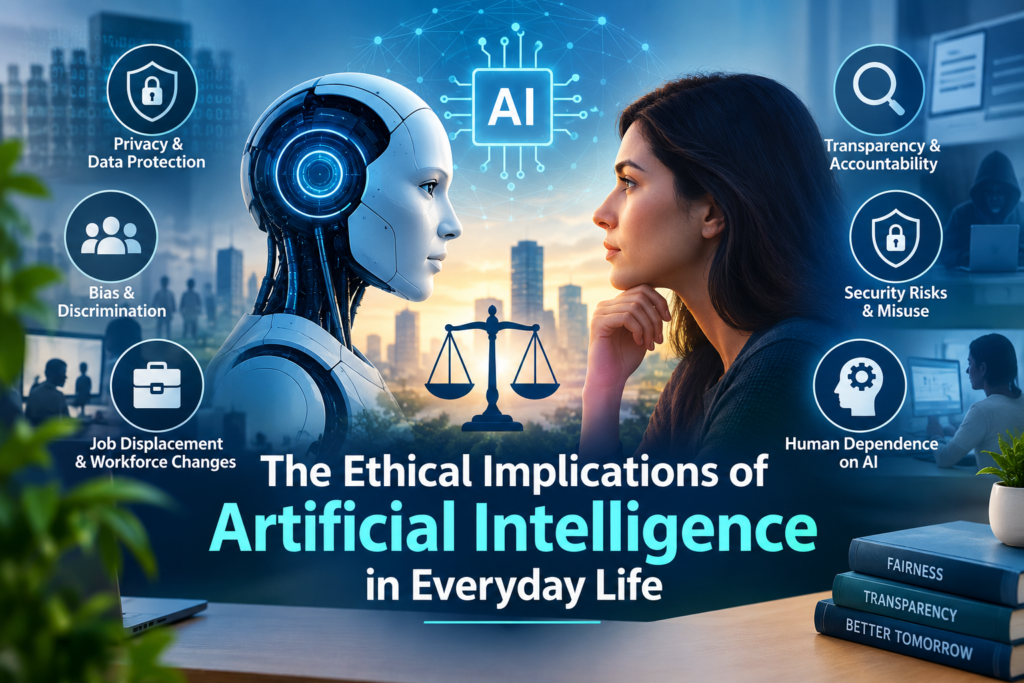
Explore the ethical implications of artificial intelligence in everyday life, including privacy, bias, employment, security, and responsible AI development.
Artificial intelligence (AI) has become an essential part of modern society. From virtual assistants and recommendation systems to healthcare technologies and self-driving vehicles, artificial intelligence is transforming how people live, work, and interact. While AI offers numerous benefits, it also raises important ethical concerns that must be addressed to ensure its responsible use.
This article explores the ethical implications of artificial intelligence, highlighting both its advantages and challenges in everyday life.
What Is Artificial Intelligence?
Artificial intelligence refers to computer systems designed to perform tasks that typically require human intelligence. These tasks include learning, problem-solving, decision-making, language understanding, and pattern recognition.
Examples of AI in daily life include:
- Voice assistants like Siri and Google Assistant
- Personalized recommendations on Netflix and YouTube
- Smart home devices
- Online customer support chatbots
- Navigation and traffic prediction systems
As AI becomes more integrated into society, understanding its ethical impact becomes increasingly important.
Why Ethics Matter in Artificial Intelligence
Ethics refers to the moral principles that guide human behavior and decision-making. Since artificial intelligence can influence important aspects of life, ethical considerations help ensure that AI systems are fair, transparent, and beneficial for everyone.
Without proper ethical guidelines, AI technologies can create risks such as discrimination, privacy violations, and misuse of personal data.
1. Privacy and Data Protection
One of the biggest ethical concerns surrounding artificial intelligence is privacy.
AI systems rely heavily on data to function effectively. Companies collect vast amounts of information, including:
- Browsing history
- Location data
- Purchase behavior
- Social media activity
- Personal preferences
While this data helps improve user experiences, it also raises concerns about how information is collected, stored, and shared.
Ethical Challenge
Users often do not fully understand how their personal data is being used. Unauthorized access or misuse of this data can lead to privacy breaches and identity theft.
Ethical Solution
Organizations should:
- Obtain clear user consent
- Protect data through strong security measures
- Follow data protection regulations
- Be transparent about data collection practices
2. Bias and Discrimination in AI Systems
Another major ethical issue in artificial intelligence is algorithmic bias.
AI systems learn from historical data. If the training data contains bias, the AI may produce unfair outcomes.
Examples
- Biased hiring software favoring certain candidates
- Facial recognition systems performing poorly on specific demographic groups
- Loan approval systems unfairly rejecting applicants
Ethical Solution
Developers must:
- Use diverse and representative datasets
- Regularly audit AI systems
- Monitor outcomes for fairness
- Reduce discriminatory patterns
Creating fair AI systems is essential for maintaining trust and equality.
3. Job Displacement and Workforce Changes
The rise of artificial intelligence has increased concerns about automation replacing human jobs.
Many routine and repetitive tasks can now be performed by AI-powered machines and software.
Industries Affected
- Manufacturing
- Customer service
- Transportation
- Retail
- Data entry
Ethical Challenge
Workers may lose employment opportunities as businesses adopt automation technologies.
Ethical Solution
Governments and organizations should invest in:
- Employee training programs
- Digital skills development
- Workforce reskilling initiatives
- New job creation in emerging industries
The goal should be to balance innovation with economic stability.
4. Transparency and Accountability
Many AI systems operate as “black boxes,” meaning their decision-making processes are difficult to understand.
When AI influences decisions related to healthcare, finance, or criminal justice, transparency becomes critical.
Ethical Challenge
If an AI system makes an incorrect decision, determining responsibility can be difficult.
Ethical Solution
Organizations should ensure:
- Explainable AI models
- Clear documentation
- Human oversight
- Accountability mechanisms
Users deserve to know how important decisions are being made.
5. Security Risks and Misuse
Artificial intelligence can improve cybersecurity, but it can also be exploited for harmful purposes.
Potential Risks
- Deepfake content
- Automated cyberattacks
- Online fraud
- Misinformation campaigns
Ethical Challenge
Malicious actors may use AI to manipulate information and deceive individuals.
Ethical Solution
Governments, technology companies, and researchers should collaborate to:
- Develop AI security standards
- Detect harmful AI-generated content
- Strengthen cybersecurity frameworks
- Promote responsible AI use
6. Human Dependence on Artificial Intelligence
As AI becomes more capable, people may become overly dependent on technology for everyday decisions.
Ethical Concern
Excessive reliance on artificial intelligence may reduce critical thinking, creativity, and human judgment.
Ethical Solution
AI should support human decision-making rather than replace it entirely. Maintaining a balance between automation and human involvement is essential.
Benefits of Ethical Artificial Intelligence
When developed responsibly, artificial intelligence can provide significant benefits:
- Improved healthcare diagnostics
- Enhanced educational experiences
- Increased workplace productivity
- Better customer service
- Safer transportation systems
- More efficient resource management
Ethical AI helps maximize these benefits while minimizing risks.
Best Practices for Responsible AI Development
To ensure ethical use of artificial intelligence, organizations should:
- Prioritize transparency and accountability.
- Protect user privacy and data security.
- Eliminate bias through regular audits.
- Maintain human oversight in critical decisions.
- Follow legal and ethical regulations.
- Promote fairness and inclusivity.
These practices contribute to building trustworthy AI systems that benefit society as a whole.
Conclusion
Artificial intelligence is reshaping everyday life in remarkable ways. From improving convenience and efficiency to driving innovation across industries, AI offers tremendous opportunities. However, the ethical implications of artificial intelligence cannot be ignored. Issues such as privacy, bias, accountability, security, and job displacement require careful consideration.
By adopting responsible development practices and prioritizing ethical principles, society can harness the power of artificial intelligence while protecting human rights, fairness, and trust. The future of AI depends not only on technological advancement but also on the ethical choices made today.