
AI Agents That Can Do Anything You Can
What They Really Do in 2026
Introduction
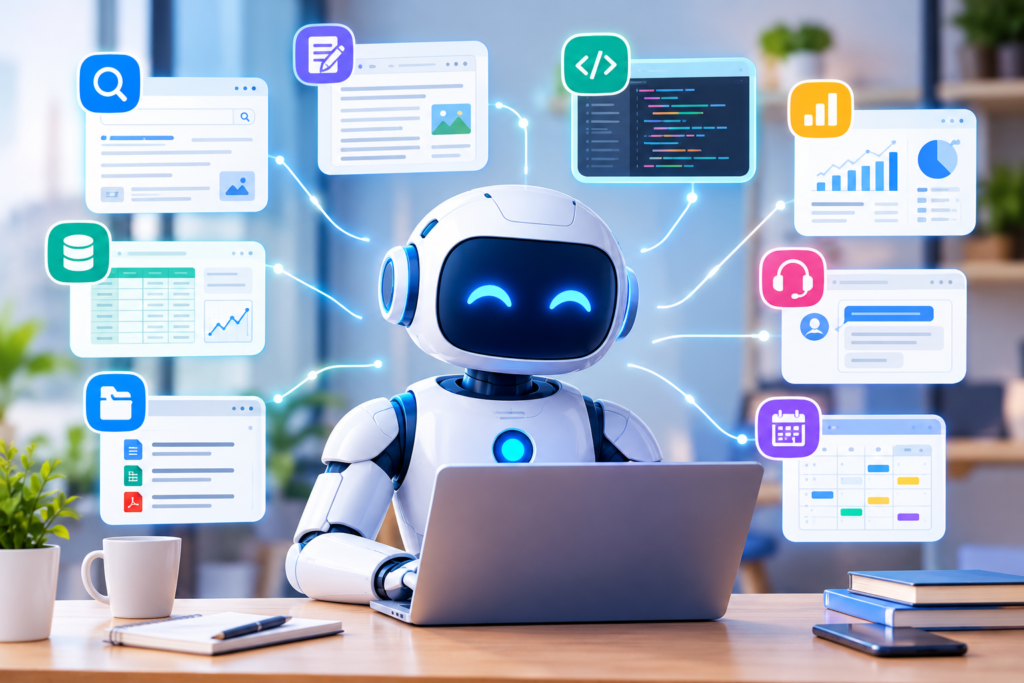
Artificial intelligence is moving beyond answering questions and generating text. A new generation of AI Agents systems can plan tasks, use digital tools, analyze information, and complete multiple steps toward a goal. These systems are commonly known as AI agents.
Imagine asking an AI tool to research a topic, compare competitors, organize the findings, prepare a report, and save the finished document. Instead of asking you what to do after every step, an AI agent may be able to carry out much of the process independently, depending on the tools and permissions available to it.
This development is changing how individuals, businesses, developers, and content creators approach everyday work.
However, the phrase “AI agents that can do anything you can” needs some context. Today’s AI agents can perform many computer-based tasks, but they cannot reliably do everything a human can do. They have limitations involving accuracy, judgment, access, security, and real-world experience.
In this guide, you will learn what AI agents are, how they work, what they can do, where they are useful, and what to consider before trusting them with important tasks.
What Are AI Agents?
AI agents are software systems that use artificial intelligence to pursue a goal by planning steps, gathering information, and taking actions through available tools.
Unlike a traditional chatbot that mainly responds to individual prompts, an AI agent can manage a sequence of connected actions. It may check its progress, respond to new information, and change its approach when something does not work as expected.
For example, a business owner could ask an AI agent to research five competitors. If the agent has web access and suitable research tools, it could find relevant websites, collect publicly available information, organize the results into a comparison table, and prepare a summary.
The agent’s actual abilities depend on its underlying AI model, connected tools, instructions, and access permissions.
How Are AI Agents Different From Regular AI Chatbots?
A regular chatbot typically answers a question or produces content. An AI agent is designed to work toward a goal and may take actions to complete it.
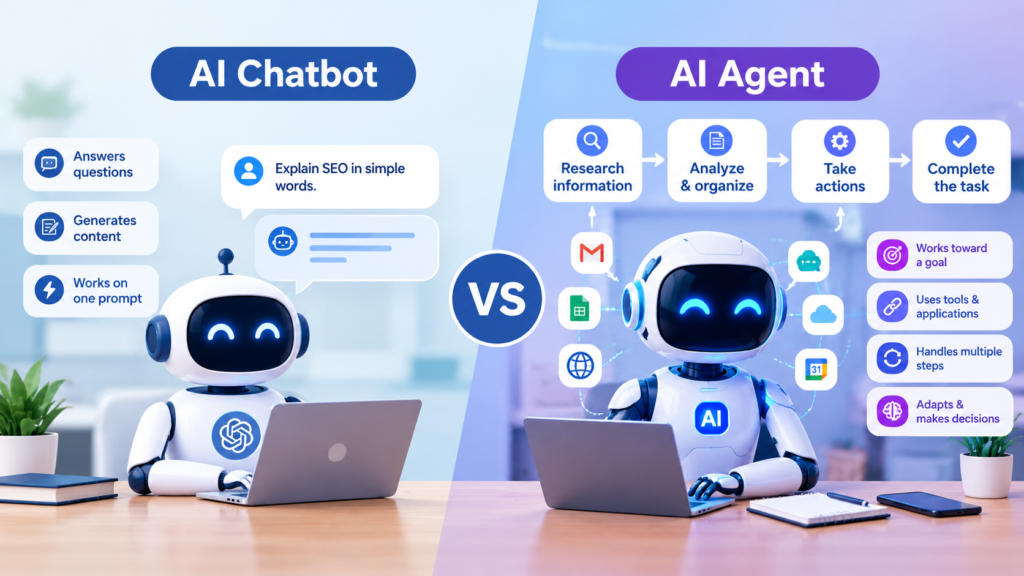
Consider these examples:
- AI chatbot: Explains how to conduct keyword research.
- AI agent: Researches keywords using available tools, organizes the results, and prepares a keyword spreadsheet.
- Traditional automation: Performs a predefined sequence of steps whenever a particular trigger occurs.
- AI agent with automation tools: Selects actions based on the task, evaluates intermediate results, and adjusts its approach when necessary.
These categories can overlap. Some modern assistants combine conversational AI, automated workflows, and agent-like capabilities.
The important distinction is not simply whether a tool uses AI. It is whether the system can plan and execute a multi-step task rather than only provide an answer.
How Do AI Agents Work?
AI agents generally combine an AI model with instructions, tools, and a process for checking the results of their actions.
Here is how a typical agent workflow operates.
1. The User Provides a Goal
The process begins when a person explains what they want to accomplish.
For example, a website owner might request a report identifying content gaps between their website and three competitors.
A clear goal helps the agent understand the expected result and the boundaries of the task.
2. The Agent Breaks the Goal Into Steps
The agent identifies the smaller activities needed to achieve the requested outcome.
For a content gap report, these steps might include identifying competitors, gathering relevant pages, grouping topics, comparing coverage, and preparing recommendations.
Complex tasks may require several rounds of planning.
3. The Agent Uses Available Tools
AI agents may use web browsers, APIs, spreadsheets, code execution environments, databases, or connected applications.
These tools allow them to move beyond generating text. For example, an agent with spreadsheet access may organize research findings in a file rather than simply describing how to create one.
However, an agent cannot automatically access every website, application, or private account. Access depends on the tools provided and the permissions granted.
4. The Agent Reviews the Results
After performing an action, the agent may examine the result and decide what to do next.
If a website fails to load, it might try another permitted approach. If research results are incomplete, it may search for additional information.
This process can continue until the task is completed, a limitation is reached, or human assistance is required.
5. The Agent Produces an Outcome
The final result might be a report, edited document, spreadsheet, software change, research summary, or completed workflow.
Human review remains important, especially when the result affects money, private information, customers, or business decisions.

What Can AI Agents Actually Do?
AI agents have practical applications across many industries. Their usefulness depends on the complexity of the task and the quality of the tools available.
1. Research and Information Gathering
AI agents can help collect and organize information from accessible sources.
Possible tasks include:
- Researching industry trends.
- Comparing competing products and services.
- Collecting publicly available company information.
- Summarizing long reports and documents.
- Preparing research briefs.
- Organizing findings into tables or spreadsheets.
For example, a marketing professional could use an agent to prepare an initial competitor analysis before reviewing the findings and deciding on a strategy.
The results should still be checked for accuracy, relevance, and source quality.
2. Content Creation and SEO
Content marketing is another area where AI agents can be useful.
With suitable research and writing tools, an agent may help with:
- Finding potential blog topics.
- Grouping related keywords by search intent.
- Creating content outlines.
- Drafting articles and meta descriptions.
- Suggesting internal links.
- Reviewing existing pages for missing information.
- Preparing content calendars.
- Summarizing performance data when analytics access is available.
For example, a website owner could request a monthly content plan based on a defined audience, existing articles, and selected keywords.
An agent could organize the plan and draft supporting content. A human editor should verify factual claims, search intent, originality, brand voice, and usefulness before publication.
Important: AI-generated content does not automatically rank well on Google. Helpful information, accuracy, originality, user experience, and appropriate SEO practices still matter.
3. Software Development
Developers can use AI agents to assist with coding and related tasks.
Depending on the environment, an agent may be able to:
- Inspect a codebase.
- Identify potential bugs.
- Suggest or implement code changes.
- Write unit tests.
- Run tests and review errors.
- Explain unfamiliar code.
- Prepare documentation.
- Assist with debugging.
For example, a developer could ask an agent to investigate a bug, identify the relevant files, propose a fix, and run available tests.
These capabilities can reduce repetitive work, but they do not guarantee secure or correct software. Code changes should be reviewed, tested, and checked for security issues before deployment.
4. Business Operations
Businesses often handle repetitive activities that involve multiple systems and documents.
AI agents may assist with:
- Preparing meeting summaries.
- Organizing project tasks.
- Drafting customer responses.
- Extracting information from documents.
- Generating recurring reports.
- Sorting support requests.
- Updating records through authorized integrations.
A small business could use an agent to prepare a weekly operations report from approved data sources.
Whether the agent can actually update a system or send a message depends on the available integrations and the permissions it has received.
5. Customer Support
AI agents can support customer service teams by gathering information, answering routine questions, and helping process requests.
For example, an agent could retrieve an order status, summarize a customer’s issue, check an applicable support policy, and prepare a response.
More advanced systems may perform parts of a customer-service workflow directly.
However, complaints involving refunds, disputed charges, sensitive personal information, or unusual circumstances may require human review. Businesses should define clear rules for escalation and approval.
6. Data Analysis and Reporting
AI agents can help users work with structured information.
Potential tasks include:
- Cleaning and organizing datasets.
- Calculating basic metrics.
- Identifying patterns and unusual values.
- Creating charts.
- Summarizing sales or website performance.
- Preparing reports from multiple data sources.
For instance, an agent with access to an approved analytics export could summarize which pages received the most visits and identify areas worth investigating.
Users should verify calculations, definitions, date ranges, and source data before making decisions based on a report.
7. Personal Productivity
AI agents may also help people organize their daily work.
Depending on connected applications, they can assist with:
- Drafting emails.
- Organizing calendars.
- Summarizing documents.
- Creating task lists.
- Preparing travel research.
- Tracking project deadlines.
- Coordinating information across applications.
Some actions, such as sending emails or making bookings, may require explicit confirmation. It is sensible to review important commitments before an agent finalizes them.
Can AI Agents Really Do Anything a Human Can Do?
The idea that AI agents can perform any task a human can do is an ambitious description of the technology, not a reliable statement of current capabilities.
AI agents are particularly useful for digital tasks that can be described clearly, performed using accessible tools, and checked against an expected result.
They are less reliable when a task requires uncertain judgment, subtle social understanding, physical interaction, or accountability for high-stakes decisions.
For example, an AI agent may help prepare a business strategy, but it cannot guarantee that the strategy will succeed. It may draft a legal document, but that does not make it a substitute for qualified legal advice. It can assist with medical information, but it should not independently replace a healthcare professional.
The key question is not whether an agent can do everything. It is whether it can complete a particular task accurately, safely, and consistently enough to be useful.
AI Agents vs. Human Workers
AI agents and human workers have different strengths. In many situations, combining them produces better results than relying entirely on either one.
| Area | AI agents | Human workers |
|---|---|---|
| Repetitive digital tasks | Can automate many routine steps | Can perform them but may spend more time |
| Information processing | Can summarize large amounts of data quickly | Can interpret context and challenge assumptions |
| Creative work | Can generate ideas and drafts | Can add personal experience and distinctive judgment |
| Decision-making | Can recommend or execute actions within defined limits | Can take responsibility and consider wider consequences |
| Emotional understanding | Can recognize some emotional signals but may misinterpret them | Can use lived experience and interpersonal judgment |
| Physical work | Usually limited without robotics or specialized hardware | Can interact directly with the physical environment |
This comparison is not absolute. AI systems vary significantly in capability, and human performance varies by skill and experience.
The most practical approach is to let AI agents handle suitable, well-defined tasks while people provide direction, judgment, and quality control.
What Are the Benefits of Using AI Agents?
When implemented carefully, AI agents can offer several advantages.
Time Savings
Agents can reduce the manual effort involved in research, document preparation, reporting, and other multi-step digital activities.
Workflow Automation
They can connect several stages of a process, reducing the need for a person to move information manually between tools.
Consistency
When given clear instructions and reliable data, agents can apply the same criteria across repeated tasks.
Support for Small Businesses
Small teams can use AI tools to assist with work that might otherwise require additional time or specialist support.
Faster Access to Information
Agents can gather and organize information from permitted sources, helping people review options more efficiently.
These benefits are not guaranteed. Poor instructions, unreliable integrations, expensive usage, or frequent errors can reduce the value of an AI agent.
What Are the Risks and Limitations of AI Agents?
Giving an AI system the ability to act introduces additional risks beyond those associated with a chatbot.
1. Incorrect Information
An agent can misunderstand a request, use outdated information, or produce an incorrect result. It may also make a mistake while carrying out an action.
2. Privacy and Security
Agents connected to email, files, business systems, or other accounts may process sensitive information. Grant only the access necessary for the task and follow your organization’s security policies.
3. Unauthorized Actions
An agent might take an unintended action if its instructions or permissions are too broad. High-impact actions should require appropriate approval.
4. Unpredictable Results
The same request may produce different results depending on available information, tool behavior, or the system’s approach.
5. Cost and Technical Complexity
Some agents require paid model usage, software subscriptions, integrations, or technical maintenance. Building and managing an agent can be more complicated than using a basic AI assistant.
6. Overreliance on Automation
Allowing an agent to make every decision without review can lead to avoidable mistakes. Human oversight is particularly important for financial transactions, publishing, customer communications, and access to sensitive systems.
A sensible rule is to begin with low-risk tasks, check the results, and expand permissions only when the system demonstrates reliable performance.
How to Start Using AI Agents
You do not need to build a complicated AI system to begin exploring agent-based work.
Follow these steps to identify a suitable use case.
Step 1: Choose a repetitive task.
Start with something that takes time but has a clear outcome, such as preparing a weekly report or organizing research.
Step 2: Define the expected result.
Explain what the agent should produce, which sources it may use, and what it must avoid doing.
Step 3: Select a suitable tool.
Choose an AI platform that supports the tools and integrations required for your task.
Step 4: Set permissions and approval rules.
Decide whether the agent may only prepare recommendations or can also make changes. Require approval for sensitive or irreversible actions.
Step 5: Test with a small task.
Review its output and note any errors, missing information, or unnecessary steps.
Step 6: Measure performance.
Compare the time saved, accuracy, cost, and amount of human correction required.
Step 7: Improve gradually.
Refine the instructions and workflow before allowing the agent to handle more complex responsibilities.
Examples of AI Agent Tools to Explore
Different platforms support different forms of agent-based work. Availability and capabilities can change, so check each provider’s current documentation before choosing a tool.
- OpenAI agent development tools: Useful for developers building applications that use AI models, tools, and multi-step workflows.
- Google’s agent development ecosystem: Offers tools for building AI agents and connecting them with supported development environments.
- GitHub Copilot coding agents: Help developers with code-related tasks in supported development workflows.
- Microsoft’s agent ecosystem: Supports building and managing agents for selected business and productivity use cases.
These are examples rather than a ranking of the best tools. The right choice depends on your budget, technical skills, workflow, privacy requirements, and required integrations.
The Future of AI Agents
AI agents are part of a broader movement toward software that can complete tasks rather than simply respond to instructions.
As these systems improve, they may become more useful for coordinating complex workflows, working across applications, analyzing information, and supporting specialized professional tasks.
Businesses may increasingly use multiple agents with different responsibilities. For example, one agent might gather information, another might analyze it, and a third might prepare a report for a person to review.
However, more autonomy also creates a greater need for security, testing, transparency, and accountability. A system that can take actions must be evaluated not only on the quality of its answers but also on the consequences of its decisions.
The future will likely involve a combination of AI automation and human supervision rather than the complete replacement of human involvement in every task.
Frequently Asked Questions
What are AI agents that can do anything you can?
The phrase describes AI systems designed to perform a broad range of tasks on a user’s behalf. In practice, current agents have specific capabilities and limitations. Their performance depends on the model, tools, permissions, and task requirements.
Are AI agents better than chatbots?
AI agents can be more useful for multi-step tasks that require planning and action. Chatbots are often sufficient for straightforward questions, explanations, and content generation. The best choice depends on what you need to accomplish.
Can AI agents work without human supervision?
Some agents can perform defined tasks with limited supervision. However, they may still need clarification, approval, or intervention when they encounter errors or unexpected situations. Important actions should have appropriate safeguards.
Can beginners use AI agents?
Yes. Beginners can start with tools that offer guided interfaces and simple workflows. No-code options may be suitable for basic tasks, while custom agents can require programming and technical knowledge.
Can AI agents replace jobs?
AI agents may automate some tasks and change how certain jobs are performed. Their effects vary by industry and occupation. Many roles also involve communication, accountability, physical activity, complex judgment, and relationships that are not easily reduced to automation.
Are AI agents free?
Some tools offer free access or limited trials, while others require subscriptions or usage-based payments. Costs may also arise from APIs, integrations, and development. Check the provider’s current pricing before committing.
Are AI agents safe to use?
They can be useful when configured carefully, but they are not risk-free. Review permissions, protect sensitive information, test actions, and require approval for consequential decisions.
Conclusion
AI agents that can do anything you can represent an exciting direction for artificial intelligence, but the reality is more specific than the headline suggests.
Today’s agents can assist with research, content creation, software development, business operations, data analysis, and personal productivity. Their greatest value comes from combining reasoning with tools that let them carry out practical, multi-step tasks.
At the same time, they can make mistakes, misunderstand instructions, and perform poorly when given unclear goals or inappropriate access.
The smartest way to use AI agents is to treat them as capable digital collaborators rather than infallible replacements for people. Start with a well-defined task, measure the results, protect your data, and maintain human oversight where it matters.
As the technology develops, people who learn to delegate appropriate work to AI agents—and evaluate their results critically—may be better positioned to benefit from the next generation of digital tools.